Facebook has become one of Papua New Guinea's most important online platforms.
Every day, Papua New Guinean creators publish Reels, videos, music, comedy, news, educational content, business information and entertainment to thousands of followers.
Yet one major opportunity remains unavailable: Facebook Content Monetization.
One explanation frequently raised is that Papua New Guinea does not yet have sufficient international payment infrastructure because services such as Stripe are unavailable locally and PayPal functionality remains limited.
But when we compare Meta's situation with other technology companies already paying creators in PNG, that explanation becomes difficult to accept on its own.
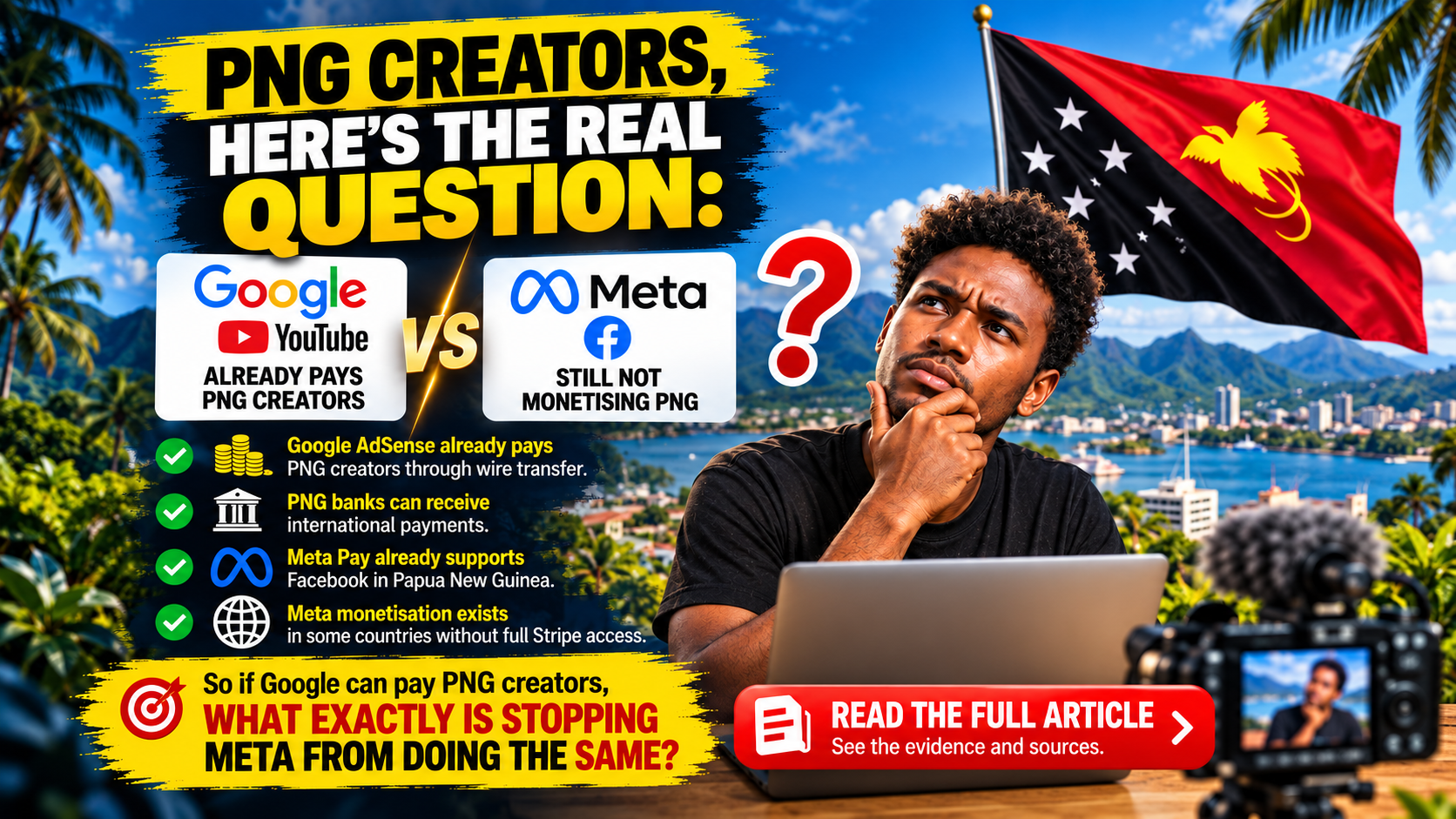
Google officially lists wire transfer as an available payment method for AdSense and YouTube accounts in Papua New Guinea.
That means eligible PNG creators can earn advertising revenue through YouTube or Google AdSense and have those earnings transferred into their bank accounts.
Source: https://support.google.com/adsense/answer/1714397
Google's international wire-transfer system allows payments to be sent using normal international banking information, including details such as a bank's SWIFT/BIC information where applicable.
Source: https://support.google.com/adsense/answer/3372975
In simple terms, the payment path can look like this:
YouTube → Google AdSense → International Wire Transfer → SWIFT Network → PNG Bank Account
That establishes an important fact.
Papua New Guinea is already capable of receiving international creator-economy payments.
Therefore, claiming that Facebook monetisation cannot operate in PNG simply because there is no way of transferring creator earnings into the country does not adequately explain the situation.
Google is already doing it.
Stripe is currently not generally available to businesses registered directly in Papua New Guinea.
Stripe's official global availability page lists countries such as Australia, New Zealand, Singapore, Malaysia, Thailand, Ghana, Kenya and Nigeria, but Papua New Guinea is not listed as a normal Stripe payments market.
Source: https://stripe.com/global
This is definitely a limitation for PNG's digital economy.
PNG businesses cannot simply open a local Stripe account in the same way that businesses in Australia or New Zealand can.
However, that does not prove that Stripe is required for Facebook creator monetisation.
There are other ways of transferring money internationally.
Google is already using one of them.
PayPal's developer documentation currently classifies Papua New Guinea as a send-only market within parts of its seller-onboarding system.
This means PNG does not have the same PayPal receiving and merchant capabilities available in fully supported countries.
Source: https://developer.paypal.com/platforms/seller-onboarding
Again, this is a genuine weakness in PNG's international digital-payment environment.
But limited PayPal availability still does not prove that Facebook Content Monetization cannot operate.
Meta does not publicly state that every country must have full PayPal receiving functionality before creators can be monetised.
This is where the payment explanation becomes much weaker.
There are countries participating in Meta monetisation programs that do not have the same Stripe infrastructure available in larger developed markets.
Bangladesh is one important example.
Bangladesh is not currently listed as a normal Stripe-supported country.
Source: https://stripe.com/global
Yet a September 2026 investigation by Dismislab found Facebook pages in Bangladesh that had been admitted into Meta monetisation programs.
The investigation identified at least 19 Facebook pages associated with Bangladeshi law-enforcement organisations that had obtained monetisation access. Some had participated in previous monetisation systems, while others had been admitted into the current Facebook Content Monetization program.
One page was reportedly admitted as recently as August 2026.
Source: https://en.dismislab.com/law-enforcement-agencies-meta-policy
There are separate questions about whether those government-related pages should have been eligible under Meta's own policies.
But for Papua New Guinea, the important finding is much simpler:
Meta is capable of operating Facebook monetisation in a country that does not have standard domestic Stripe availability.
That means:
No Stripe does not automatically mean no Facebook monetisation.
Another important piece of evidence comes directly from Meta.
Meta's official Meta Pay availability information lists Papua New Guinea as a supported Facebook market in the Asia-Pacific region.
Source: https://meta.com/meta-pay/availability
Meta Pay and Facebook Content Monetization are not the same product.
Meta Pay is used for certain transactions across Meta's platforms, while Facebook Content Monetization involves Meta paying eligible creators.
Meta explains Meta Pay separately as its payment technology for supported transactions across Facebook and other Meta services.
Source: https://meta.com/meta-pay
So Meta Pay availability does not mean creator payouts have already been configured for PNG.
But it proves something else:
Meta does not completely exclude Papua New Guinea from its payments infrastructure.
Some Meta financial functionality already operates in PNG.
The evidence suggests that the answer is more complicated.
We cannot say payments have nothing to do with the problem.
Meta may use a particular payout provider that does not support PNG.
Meta may require specific banking integrations.
It could require additional KYC infrastructure.
There could be tax-reporting requirements.
There could be compliance or anti-money-laundering concerns.
There could also be commercial reasons related to advertising demand, market size or Meta's rollout priorities.
But those are very different issues from saying:
"PNG cannot receive international payments."
That statement is demonstrably inaccurate because Google already sends creator earnings to Papua New Guinea through international wire transfers.
Papua New Guinea was placed under increased monitoring by the Financial Action Task Force in February 2026.
FATF said PNG had committed to improving areas including anti-money-laundering supervision, investigations, suspicious-transaction reporting and international cooperation.
That could increase compliance requirements for international technology companies operating financial or payout systems in PNG.
However, there is currently no public evidence from Meta establishing that PNG's FATF status is the specific reason Facebook monetisation is unavailable.
It should therefore be considered a possible contributing factor, not a confirmed explanation.
Facebook Content Monetization is not simply a payment feature.
Meta controls admission into the program.
In March 2026, Meta explained that Facebook Content Monetization remained invite-only, although creators could express interest through their Professional Dashboard.
Source: https://about.fb.com/news/2026/03/creator-fast-track-grow-your-audience-earn-money-on-facebook
Meta has also said that its monetisation systems increasingly reward original content and use factors including qualified views, engagement and content performance when determining earnings.
Source: https://about.fb.com/news/2026/03/rewarding-original-creators-on-facebook
This means Meta's monetisation ecosystem involves much more than transferring money into a bank account.
The company has to enable countries within a much larger system involving creator eligibility, compliance, taxation, banking, advertising, fraud prevention and payout operations.
The biggest finding from this comparison is simple.
Instead of asking:
"How can Facebook monetisation work in PNG without Stripe or PayPal?"
The better question is:
"If Google can already pay Papua New Guinean creators through international wire transfers, why hasn't Meta established a similar payout arrangement?"
Google has already demonstrated that revenue generated by an international digital platform can be paid into Papua New Guinean bank accounts.
The international banking infrastructure already exists.
That does not mean Meta can simply copy Google's system.
Google and Meta use different banking partners, payment providers, compliance systems and internal infrastructure.
But it does prove that PNG's banking system is not fundamentally incapable of receiving digital creator earnings.
Instead of giving Papua New Guinean creators a general explanation about payment infrastructure, Meta could provide much more useful information by identifying the exact outstanding requirement.
For example:
Is PNG missing a specific banking integration?
Is there an unresolved taxation issue?
Does Meta require additional KYC infrastructure?
Is Meta's payout partner unable to operate in PNG?
Is there a specific AML or compliance concern?
Is advertising demand in PNG considered too low?
Does Meta require additional regulatory agreements?
Or has Papua New Guinea simply not yet been prioritised in Meta's rollout?
Those are very different issues.
And until Meta identifies the actual requirement, blaming Stripe or PayPal alone does not satisfactorily explain PNG's exclusion.
After comparing Google's payment system, Stripe availability, PayPal restrictions and Meta's operations in other markets, the strongest conclusion is:
Lack of basic international payment capability does not adequately explain why Facebook Content Monetization remains unavailable in Papua New Guinea.
Google already supports international wire-transfer payments to PNG AdSense and YouTube creators.
Source: https://support.google.com/adsense/answer/1714397
Papua New Guinea already participates in the global SWIFT banking system.
Meta Pay already lists Facebook availability for Papua New Guinea.
Source: https://meta.com/meta-pay/availability
And evidence from markets such as Bangladesh shows that the absence of normal Stripe availability does not automatically prevent Meta from enabling monetisation.
Sources:
https://stripe.com/global
en.dismislab.com/law-enforcement-agencies-meta-policy
This does not prove that payment infrastructure plays no role.
Meta may still face problems involving its own payout provider, KYC requirements, banking arrangements, tax systems or compliance framework.
But that is fundamentally different from saying PNG has no way of receiving the money.
The available evidence instead points towards a broader issue:
Meta has not yet fully enabled Papua New Guinea within its creator monetisation ecosystem.
Exactly why remains unanswered.
For Papua New Guinean creators, government agencies and the technology sector, the question to Meta should therefore be:
If Google can already pay Papua New Guinean creators through international wire transfers, and Meta can operate monetisation in countries without full Stripe availability, what exact technical, regulatory, financial or commercial requirement is preventing Facebook Content Monetization from being enabled in Papua New Guinea?
Until that question is answered, blaming the absence of Stripe or full PayPal functionality alone is not enough.
Google has already demonstrated that PNG creators can be paid.
The real question remains:
Contact Embakai Tech Solutions for a focused review, implementation plan or quote for your organisation in Papua New Guinea.