A good website designer should do more than make your website look nice.
They should understand your brand.
Your brand is not just your logo. It is how your business is seen, remembered, trusted, and recognised by customers. It includes your name, logo, colours, fonts, tone of voice, services, values, customer experience, and the feeling people get when they interact with your business.
When a designer understands your brand, the final website feels like your business. It does not look like a random template with your logo pasted on top. It feels consistent, professional, and built for your specific audience.
For SMEs in Papua New Guinea, this matters. Many customers will first see your business through Facebook, Google, WhatsApp, referrals, flyers, signs, or your website. If your branding is inconsistent, unclear, or poorly designed, customers may not trust the business as quickly.
A professional designer should be able to take your business identity and turn it into a website that communicates clearly, looks credible, and supports your business goals.
But how do you know if a designer truly understands your brand before you pay them?
This guide explains the signs to look for, the questions to ask, and the red flags to avoid.
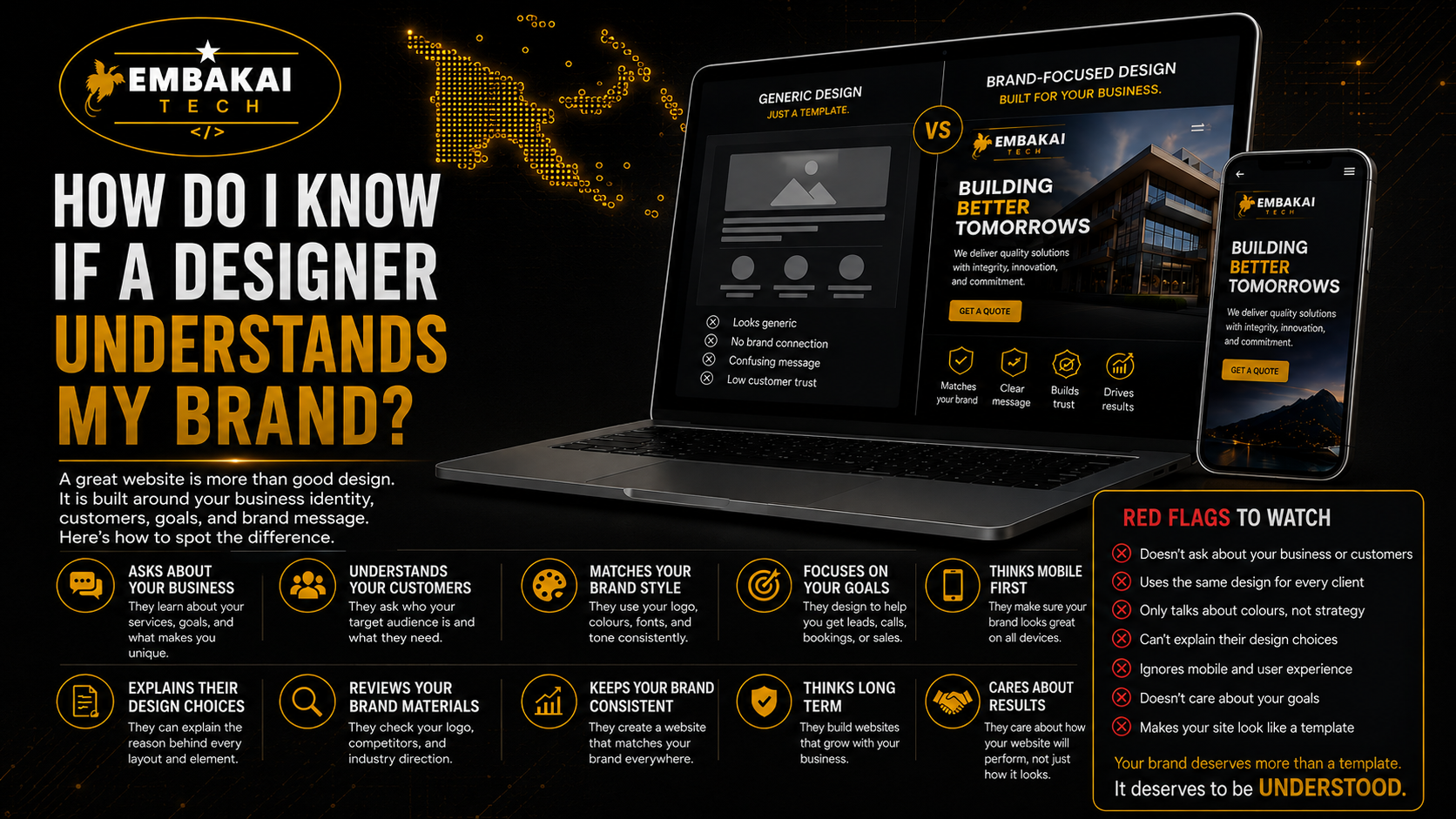
A designer understands your brand when they understand more than just your preferred colours.
They should understand:
For example, a website for a law firm should feel trustworthy, structured, and professional. A website for an online shop should feel easy to browse, product-focused, and simple to buy from. A website for a construction company should feel strong, reliable, and project-driven. A website for a technology company should feel modern, fast, secure, and solution-focused.
If a designer gives every business the same layout, same colours, same icons, and same structure, they are not really designing around the brand. They are just filling a template.
A brand-focused designer should ask questions before designing.
One of the clearest signs that a designer understands branding is that they ask about your business first.
Before choosing colours or layouts, they should want to know:
If a designer immediately jumps into design without asking these questions, that is a warning sign.
A website should be built around business goals, not personal taste.
For example, you may like a certain colour or style, but if it does not fit your business audience, it may not be the best choice. A good designer will explain that professionally and guide you toward a better decision.
Design is not decoration. Design is communication.
Your website is not mainly for you. It is for your customers.
A designer who understands your brand should ask about the people who will use the website.
They may ask:
This is important because different audiences need different design approaches.
For example, a website targeting corporate clients should look more structured and professional. A website targeting young customers may use stronger visuals and simpler direct messages. A website for rural or mobile-first users should be very simple, fast, and easy to navigate.
If the designer does not ask about your customers, they may create a website that looks good but does not connect with the people you want to reach.
A serious designer should ask to see your existing brand materials.
These may include:
This helps the designer understand what your brand already looks like and whether it needs to be maintained, improved, or redesigned.
If your existing branding is strong, the website should follow that direction.
If your existing branding is weak, outdated, blurry, inconsistent, or incomplete, the designer should explain what needs improvement before building the website.
For example, if your logo is low resolution, the designer may ask for a better file or suggest cleaning it up. If your Facebook graphics use completely different colours from your logo, they may recommend creating a consistent brand palette.
A designer who ignores your existing materials may create a website that does not match your business identity.
A good designer should listen to your preferences, but they should also guide you with professional advice.
There is a difference between:
A designer who understands your brand should not only follow every request blindly. They should explain why something works or does not work.
For example, if you ask for too many colours, the designer may explain that it can make the website look messy. If you want a very large logo in every section, they may explain that it can distract from the main message. If you want too much text on the homepage, they may recommend breaking it into clearer sections.
This does not mean the designer should ignore you. It means they should combine your business knowledge with design strategy.
The best result comes when the business owner understands the business and the designer understands how to present it professionally.
A designer who understands your brand should be able to explain the design direction before or during the project.
They should be able to say things like:
If the designer cannot explain why they are making certain design choices, they may not have a clear strategy.
Good design decisions should have reasons.
For example:
A designer who understands your brand can explain the thinking behind the design.
Different industries need different design approaches.
A strong designer should understand that a website for a school should not look like a nightclub flyer. A law firm should not look like a gaming website. A medical clinic should not look like a fashion store. A construction company should not look like a personal blog.
Your website style should match your industry and customer expectations.
For example:
The design should feel professional, clean, structured, and trust-focused.
The design should show strength, reliability, completed projects, services, safety, and capability.
The design should focus on products, categories, price visibility, checkout flow, trust, and mobile shopping.
The design should clearly show courses, registration options, schedules, benefits, certificates, and contact details.
The design should focus on mission, community, programs, donations, events, and trust.
The design should feel modern, secure, fast, solution-driven, and innovation-focused.
If a designer uses the same style for every industry, the result may feel generic.
A brand-focused designer adjusts the design to fit the business type.
Your logo is important, but your brand message is just as important.
A designer should understand what your business needs to say.
This includes:
For example, a homepage should quickly answer:
If a designer only focuses on the logo and colours but ignores the message, the website may look nice but fail to communicate.
A good website should combine design and content.
The design brings attention. The message builds understanding. The call-to-action creates movement.
A designer who understands your brand should think beyond the website.
Your brand may appear on:
Your website should not feel separate from these materials. It should feel like part of the same identity.
Good branding uses consistent:
When customers see your website after seeing your Facebook page or flyer, they should immediately recognise the business.
Consistency builds trust and makes your marketing more memorable.
In Papua New Guinea, many customers access websites on mobile phones.
A designer who understands your brand should make sure the brand still looks professional on small screens.
This means checking:
A brand may look great on a desktop screen but fail on mobile if not designed properly.
If your customers mostly use phones, the mobile version may be more important than the desktop version.
A professional designer should not treat mobile design as an afterthought.
A website should support where your business is going, not only where it is today.
A designer who understands your brand may ask:
This matters because a website should be built with room to grow.
For example, a business may start with a simple website but later add an online shop, booking form, blog, customer dashboard, or payment gateway. A good designer will think about structure from the beginning.
If the website is built without future planning, it may need to be rebuilt too soon.
A good designer does not only say yes.
They should be able to tell you when something does not fit your brand.
For example:
This kind of feedback is valuable.
You are not hiring a designer just to agree with you. You are hiring them to help present your business properly.
A designer who understands your brand should protect your brand from poor design decisions.
When the designer presents a draft or mockup, compare it with what you told them.
Ask yourself:
If the design feels completely unrelated to your business, the designer may not have understood the brand.
However, also be open to professional interpretation. A designer may improve your brand direction in a way that looks better than what you first imagined.
The key question is not “Is this exactly what I pictured?”
The better question is:
Does this represent my business clearly and professionally?
Be careful if a designer:
These signs do not always mean the designer is bad, but they do show a weak branding process.
Before hiring a designer, ask:
The answers will show whether the designer has a real branding process or is just building a template.
To help the designer understand your brand, prepare:
The more information you provide, the better the designer can understand your brand.
However, a good designer should also help you organise unclear ideas.
You do not need to have everything perfect before starting. But you should be ready to explain your business clearly.
Embakai Tech Solutions helps businesses in Papua New Guinea build websites that match their brand, industry, goals, and customers.
We help with:
Our goal is to make sure your website does not look like a random template. It should look and feel like your business.
A strong website should reflect your identity, communicate clearly, and help customers trust you faster.
You know a designer understands your brand when they ask the right questions, study your business, review your logo and materials, understand your customers, explain their design choices, and create a website that feels consistent with your identity.
A good designer does not just ask what colour you like. They ask what your business stands for, who you serve, what customers need to see, and how the website should support your goals.
Your brand deserves more than a generic layout.
For SMEs in Papua New Guinea, a professional website should build trust, improve recognition, support marketing, and make your business easier to understand.
If the designer understands your brand, the website will feel clear, consistent, and professional.
If they do not, the website may look good on the surface but fail to represent your business properly.
Choose a designer who understands both design and business.
Embakai Tech Solutions helps SMEs, startups, organisations, and entrepreneurs in Papua New Guinea build brand-focused websites that match their logo, colours, message, customers, and business goals.
We create websites that are professional, mobile-friendly, secure, SEO-ready, and built to support your growth.
Contact Embakai Tech Solutions today and build a website that truly represents your business.
Contact Embakai Tech Solutions for a focused review, implementation plan or quote for your organisation in Papua New Guinea.