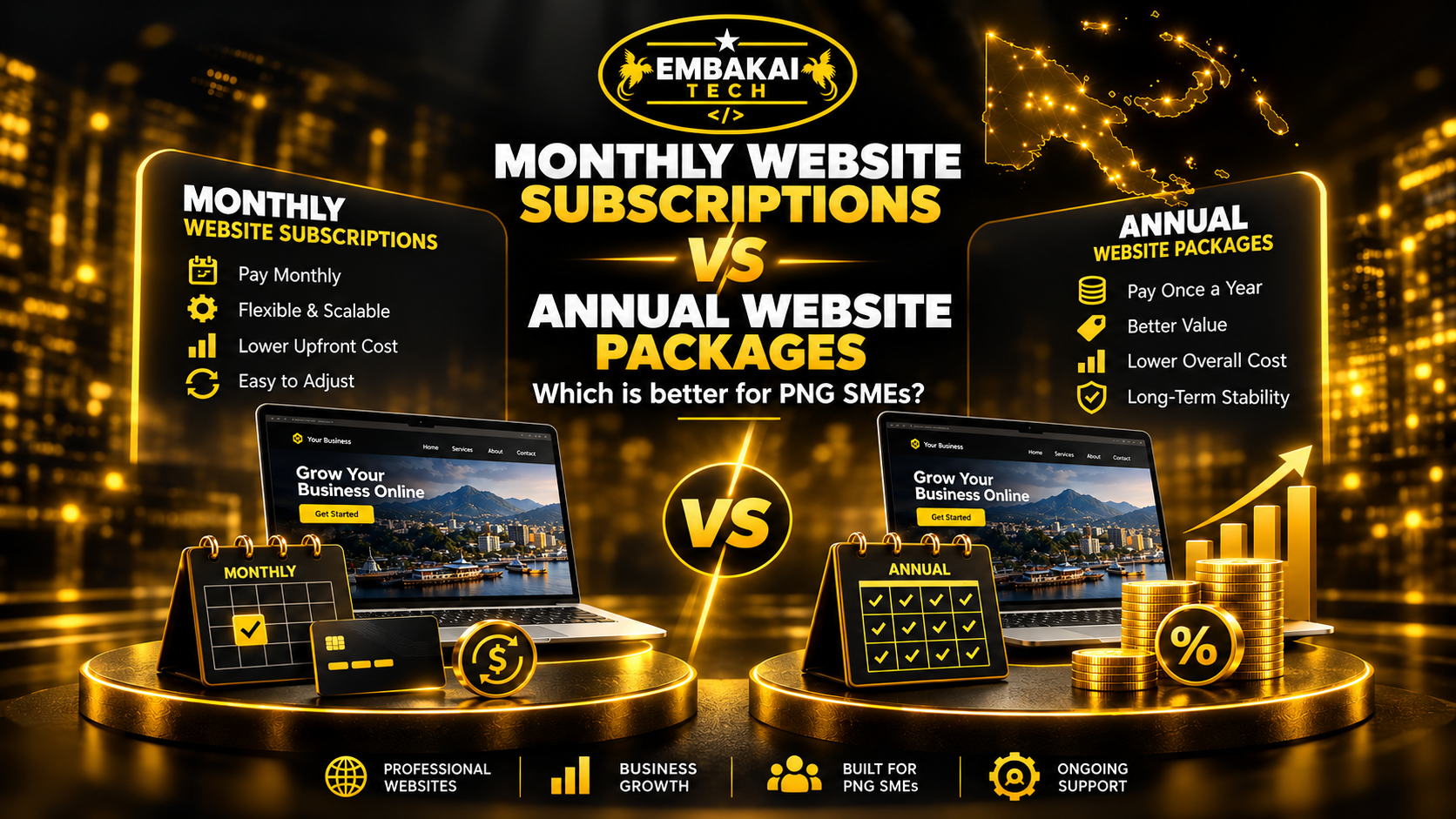
When planning a business website, one of the first questions many business owners in Papua New Guinea ask is:
“How much will it cost?”
But there is another question that deserves just as much attention:
“How will I be paying for this website over the next few years?”
Some website providers offer monthly subscriptions, where businesses pay a recurring fee to keep their website running.
Others provide annual website packages, where the customer pays once for a defined 12-month service period.
Both pricing models can work.
The problem is that many business owners compare only the amount they need to pay today, without considering what they will spend over the next one, two, or three years.
For example, a website advertised for K150 per month may seem more affordable than an annual package costing K1,500.
But after 12 months, the monthly subscription totals K1,800.
After three years, assuming the price remains unchanged, that becomes K5,400.
An annual package costing K1,500 per year would total K4,500 over the same period.
That is a K900 difference.
However, the cheaper option is not automatically the better option.
The monthly service might include ongoing website updates, content changes, priority support, or other services that the annual package does not provide.
This is why PNG businesses need to look beyond the advertised price.
The right decision depends on the total cost, included services, contract conditions, website ownership, cancellation policies, and long-term business requirements.
In this guide, we compare monthly website subscriptions and annual website packages to help PNG SMEs understand what they are paying for and which approach provides better value.
A monthly website subscription is a pricing arrangement where a business pays a recurring fee for website-related services.
Depending on the provider, the monthly payment may cover:
The exact inclusions vary significantly.
Some providers combine the initial website development cost with ongoing hosting and maintenance into one monthly payment.
Others charge an initial development or setup fee, followed by monthly payments for hosting and support.
For example, a business may receive a quotation of:
Website setup: K300
Monthly subscription: K150
The customer pays the setup fee and then continues paying K150 each month under the agreed terms.
This can make the initial cost easier to manage, particularly for businesses with limited cash available at the beginning.
But the monthly payment becomes an ongoing business expense.
You need to understand exactly what happens when those payments stop.
An annual website package is an arrangement where the customer pays for a defined yearly service period.
Depending on the provider, the package may include:
For example:
Annual website package: K1,500 per year
The customer makes one payment covering the services specified in the agreement for 12 months.
At the end of the service period, the customer renews to keep the relevant recurring services active.
However, an important distinction must be understood.
The initial development price and the annual renewal price are not always the same.
Some providers charge a separate one-time development fee and an annual hosting and maintenance fee.
Other providers bundle the initial website development and first year's recurring services into one package.
A business should therefore confirm the first-year cost and subsequent renewal cost separately.
An annual package does not mean the website is free to operate after the first year.
Domains, hosting, and other recurring services still need to be maintained and renewed.
| Factor | Monthly Subscription | Annual Package |
|---|---|---|
| Payment schedule | Usually every month | Usually once per year |
| Initial payment | May be lower | May require more upfront |
| Long-term cost | Depends on monthly rate and extras | Depends on annual rate and extras |
| Hosting | May be included | May be included |
| Domain | May be included or billed separately | May be included or billed separately |
| Maintenance | Varies by plan | Varies by plan |
| Content updates | May be included | May be included or charged separately |
| Contract duration | Monthly or fixed-term | Commonly 12-month service period |
| Cancellation | Depends on the agreement | Depends on the agreement |
| Ownership and access | Depends on contract and platform | Depends on contract and platform |
| Best suited for | Businesses needing smaller recurring payments | Businesses preferring predictable annual budgeting |
Neither pricing model guarantees better website quality.
The most important factors are the actual service scope, provider reliability, and agreement terms.
One of the biggest mistakes businesses make is comparing a monthly price with an annual price without calculating the full cost.
Consider this illustrative example.
A PNG business receives two website quotations.
Provider A offers:
K150 per month.
Provider B offers:
K1,500 per year.
Assume both packages provide equivalent services, neither has a separate setup fee, and prices remain unchanged.
| Period | Monthly at K150 | Annual at K1,500 | Annual Savings |
|---|---|---|---|
| 12 months | K1,800 | K1,500 | K300 |
| 24 months | K3,600 | K3,000 | K600 |
| 36 months | K5,400 | K4,500 | K900 |
These figures are illustrative, not current market quotations.
The comparison demonstrates why payment frequency matters.
A monthly rate may appear smaller because the cost is spread throughout the year.
But over several years, the total can become significantly higher.
However, the calculation is only fair when both providers offer comparable services.
If the K150 monthly package includes regular content updates while the K1,500 annual package does not, those differences must be considered.
Always compare equivalent services before deciding which quotation is cheaper.
Not every website subscription includes the complete development cost.
Some providers advertise a monthly rate but also charge:
For example:
Monthly subscription: K150
One-time setup fee: K300
The first-year total becomes:
K150 × 12 = K1,800
K1,800 + K300 = K2,100
If you only compare the advertised K150 monthly rate against a K1,500 annual package, you may overlook the additional K300.
This is why business owners should request a quotation showing the complete first-year cost.
A proper quotation should make clear which charges are one-time and which will recur.
A website quotation should not be judged by price alone.
Two providers might advertise the same amount but deliver very different services.
For example, one package may include only a three-page website and basic hosting.
Another may include eight pages, business email, contact forms, SSL, backups, and support.
Before comparing prices, check the package's actual features.
How many pages are included?
For example:
Does the package allow additional pages?
What happens if your business expands?
Is the domain included?
Which extension is covered?
For example:
.com
.com.pg
.pg
Some domain extensions have different registration requirements and costs.
A provider advertising a free domain may only include selected extensions.
What hosting resources are included?
Check storage, bandwidth, website limits, database support, and any applicable CPU or memory restrictions.
Are professional email accounts included?
How many?
What storage is provided?
Does the package include HTTPS, appropriate security configuration, spam protection, and updates?
Are backups provided?
How frequently?
Can the provider restore the website when necessary?
What type of support is included?
Does support cover website errors only, or does it also cover design changes and content updates?
The service coverage should be clearly documented.
This distinction is important.
Many businesses assume website maintenance means the provider will make unlimited changes whenever requested.
That is not necessarily true.
Technical maintenance may include:
Content updates are different.
They may involve:
A provider may include technical maintenance but charge separately for content changes.
Another provider may include a limited number of content updates per month.
These arrangements can exist under either monthly or annual billing.
Before signing an agreement, ask:
“Does this price include ongoing content changes, or only technical maintenance?”
That question can prevent misunderstandings later.
For a newly established PNG SME, cash flow can be more important than total long-term cost.
The business may already be paying for:
Paying K1,500 at once may be difficult.
A monthly website subscription could allow the business to establish its online presence without a large initial payment.
This may be useful when:
But businesses should not assume that a subscription can be cancelled at any time.
Some providers require a minimum contract period.
A low monthly price may come with a commitment of 12 months or longer.
That needs to be checked before signing.
An established business may prefer knowing its website-related costs for the year in advance.
Instead of processing 12 separate payments, the business makes one annual payment under its service agreement.
This can simplify budgeting.
For example, a company may organise its digital expenses around annual renewals for:
Annual billing may also cost less when the provider offers a lower equivalent rate in return for upfront payment.
For a business that expects to operate its website continuously for several years, an annual arrangement can be practical.
However, paying annually is not automatically cheaper.
A provider's annual package may still cost more if it includes unnecessary features or charges significantly higher fees.
Always check the total cost and service coverage.
Payment frequency and contract duration are not the same thing.
A website provider may charge monthly while requiring a 12-month commitment.
For example:
K150 per month with a 12-month contract.
The customer may be required to continue paying for the agreed minimum term even if they decide to stop using the website after several months.
Another provider may offer genuine month-to-month billing with cancellation permitted before the next billing cycle.
These are different arrangements.
An annual package also has its own terms.
It may be prepaid for 12 months, with renewal required at the end of the period.
Before agreeing to any package, confirm:
Do not rely only on the headline price.
Read the actual agreement.
Cancellation is one of the most important issues to understand.
Some website subscriptions are based on proprietary website-building platforms.
The provider may manage the design, hosting, platform, and software as a single service.
When the subscription ends, the customer may lose access to the hosted website.
Depending on the agreement, the business may be able to export some content but not the complete application or platform.
For example, you might retain your company photographs and text while losing access to the proprietary page builder used to display them.
Other subscriptions use WordPress or conventional hosting and may provide a more straightforward migration path.
That is why you should ask:
If I cancel, can I move the website to another provider?
What files, content, and data will I receive?
Will the website continue working after cancellation?
The answer should be provided before the business signs up.
Annual website packages also have renewal conditions.
When the agreed service period ends, several things may happen depending on the contract and the services involved.
Your hosting service may be suspended or terminated after the relevant grace period.
Your domain registration may expire if it is not renewed.
Your business email may stop working if its hosting or domain is affected.
This is why annual renewal should not be treated as an optional maintenance expense.
Some services must remain active for the website to continue operating.
However, an expired hosting agreement does not automatically mean a provider owns your website content or custom source code.
Contractual rights, licences, account access, and data retention are separate issues.
Before the renewal date, businesses should confirm the amount payable and understand what will happen if the agreement is not renewed.
Another common misunderstanding is that an annual website package automatically gives the customer full ownership while a monthly subscription does not.
That is not necessarily true.
Ownership and access depend on the agreement, not simply whether you pay monthly or annually.
A monthly package may include a website whose custom code belongs to the client under a written agreement.
An annual package may provide access to a managed website platform without transferring ownership of its underlying proprietary software.
Important questions include:
Businesses should understand these matters regardless of the payment model.
Paying an annual hosting fee does not mean you have purchased the hosting server.
Similarly, paying a monthly subscription does not automatically mean the developer owns your entire website.
Hosting is normally a continuing service.
The provider supplies infrastructure to keep the website online.
Website development, source-code rights, content ownership, and hosting are separate matters.
For example, a PNG business may own or have sufficient rights to use its website application while paying a hosting company each year to operate it.
If it stops paying for hosting, the website may go offline.
That does not necessarily remove the business's rights in the code or content.
A professional service agreement should explain these distinctions.
Some subscription services renew automatically.
This can be convenient because it reduces the risk of accidentally missing a payment.
However, business owners should understand:
Annual services can also renew automatically, depending on the provider.
Others require a manual invoice and upfront payment before renewal.
For businesses managing several subscriptions, recurring charges can become difficult to track.
Keep a record of all website-related payments.
A single K100 or K150 monthly subscription may not seem expensive.
But a business may also pay separately for:
These additional charges can increase the real operating cost.
For example, imagine a business paying K150 per month for website services while separately paying annual fees for domain registration and business email.
The advertised subscription price is not the complete cost.
The same problem can occur with an annual package if important services are excluded.
A proper comparison should include all compulsory costs needed to keep the website functioning as intended.
A website is normally a long-term business investment.
That is why it makes sense to compare costs over at least three years, especially if you expect the website to remain active.
Use this simple approach:
Three-Year Cost = Initial Development or Setup + Recurring Fees for 36 Months + Required Extras
For an annual package:
Three-Year Cost = Initial Development or Setup + Annual Fees for Three Years + Required Extras
The calculation should include domain renewals, hosting, maintenance, email, and other compulsory charges where they are not already bundled.
For example, if a provider charges K2,000 for initial development and K800 for each subsequent year's hosting and maintenance, the three-year cost would be:
K2,000 + K800 + K800 = K3,600
That assumes the first year's recurring services are included in the initial K2,000.
If they are not, the calculation changes.
Always confirm what the first invoice covers.
Avoid assuming that every year will cost the same amount.
A website billed monthly is not automatically lower quality.
A website billed annually is not automatically better.
What matters is the actual quality of the work.
A professional website should be:
A poorly developed website remains poor regardless of whether it costs K100 per month or K2,000 per year.
Likewise, a professionally developed website can operate successfully under either payment arrangement.
Businesses should evaluate the provider's portfolio, technical capability, support arrangements, and contract terms alongside the price.
Technical support can mean different things.
Some website packages include help when the website is unavailable.
Others provide support only for hosting infrastructure.
Some include assistance with software updates.
Others include a limited amount of content management.
A monthly subscription may provide ongoing support as part of its value.
An annual package may also include support, but the scope and response arrangements can differ.
Before paying, ask:
What problems are covered by the package?
How do I request assistance?
Are there additional charges for changes?
What happens if the website is hacked?
Does the provider maintain backups?
What happens if my business needs a new feature?
These details can make a bigger difference than the billing frequency itself.
The pricing decision becomes more complicated when the website has advanced functionality.
A basic company website has different requirements from an online shop or custom application.
An e-commerce system may require:
A custom web application may require database development, user permissions, APIs, dashboards, background processing, and ongoing application maintenance.
These systems may need a separate development quotation.
Monthly or annual hosting fees should not automatically be assumed to cover unlimited development.
A business should confirm the initial build cost, recurring infrastructure costs, maintenance arrangements, and future feature charges.
For more complex systems, clear project milestones and a defined maintenance agreement may be more important than choosing one billing schedule over the other.
A monthly subscription may be appropriate when:
For some startups and small businesses, the convenience of predictable monthly payments may outweigh a modest difference in total cost.
The important thing is understanding what you receive in exchange.
An annual package may be appropriate when:
For many established PNG SMEs, annual billing can provide a practical way to manage ongoing website costs.
It may also be attractive when the provider offers a lower annual equivalent than comparable monthly services.
But the decision should still be based on total value.
Before accepting a monthly or annual website quotation, ask the provider:
A professional provider should be able to explain these matters before the customer commits.
A website should help your business present itself professionally, communicate with customers, and support enquiries or sales.
The right package should provide enough capability for the business without creating unnecessary financial pressure.
If an annual package saves money over three years and includes everything you need, it may offer better long-term value.
If a monthly subscription provides valuable ongoing content updates and reduces initial financial pressure, it may justify a higher total cost.
There is no universal answer.
The key is understanding the trade-off between:
Initial Cost → Ongoing Cost → Service Coverage → Contract Terms → Business Control → Long-Term Value
When businesses compare all six, the decision becomes much clearer.
Embakai Tech Solutions provides website development and related digital services for businesses, organisations, startups, and entrepreneurs in Papua New Guinea.
Our website service model uses annual billing rather than recurring monthly subscription charges.
Depending on the selected service and agreed quotation, arrangements may cover areas such as:
Specific features, page limits, email allowances, development scope, renewal costs, and support obligations are confirmed in the applicable package or quotation.
Annual billing allows customers to plan their recurring website expenses around a defined yearly service period.
It is also important to distinguish initial development charges from annual domain, hosting, and maintenance renewals.
A business website requires suitable infrastructure to remain operational, and those services cannot simply be placed on hold indefinitely without considering the provider's recurring costs and service terms.
The objective should always be to provide a clear understanding of what the customer is paying for.
Monthly website subscriptions and annual website packages both have advantages.
A monthly subscription can make it easier to start a website with a smaller initial payment.
An annual package can simplify budgeting and may offer lower total costs when comparable services are included.
But neither model is automatically better.
A website advertised at K150 per month may eventually cost more than an annual package.
An annual package may also become poor value if important services are excluded or renewal conditions are unclear.
The right decision depends on:
For PNG SMEs, the most important lesson is simple:
Do not choose a website package based only on how small the first payment looks.
Understand the complete financial and technical arrangement before you commit.
A professional website is a continuing business investment.
Choose a pricing model that your business can afford, understand, and maintain over the long term.
Planning a new business website but unsure whether monthly subscriptions or annual packages provide better value?
Embakai Tech Solutions offers annual website solutions for PNG businesses, with services and renewal arrangements defined in the applicable quotation.
Whether you need a company website, online store, professional business email, hosting, domain registration, or custom web development, we can help you select an appropriate solution based on your requirements.
Know the total cost. Understand the agreement. Invest in the right website.
Contact Embakai Tech Solutions for a focused review, implementation plan or quote for your organisation in Papua New Guinea.