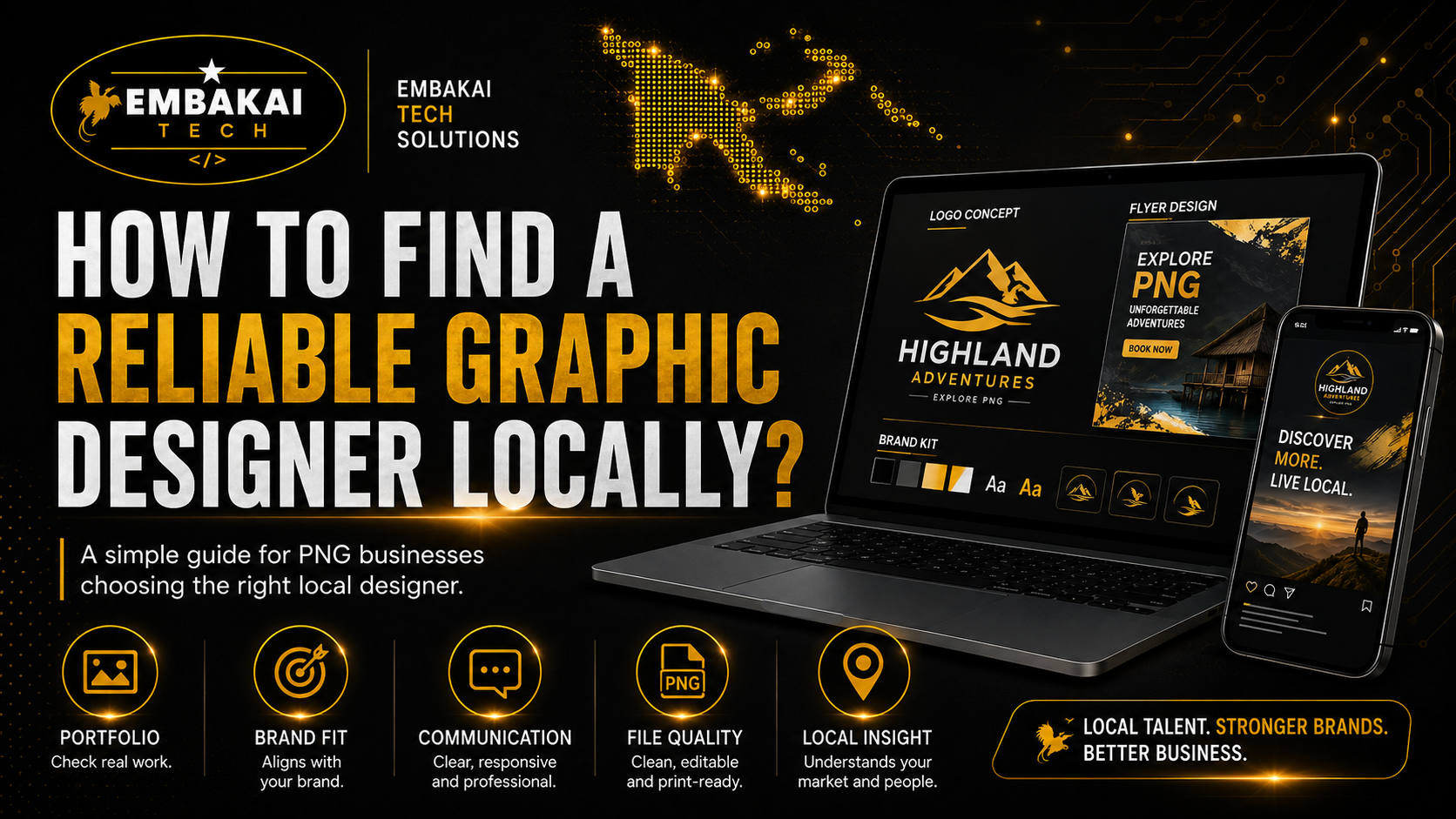
Finding a reliable graphic designer locally can be difficult, especially when your business needs professional branding, a logo, flyers, social media graphics, banners, business cards, website visuals, or marketing materials.
Many business owners in Papua New Guinea first look for a designer when they need something urgent. Maybe they need a logo for a new business, a flyer for a promotion, a poster for an event, or graphics for a Facebook ad. Because they are in a rush, they may choose the first person who replies or the cheapest person available.
That can become a problem.
A good graphic designer does more than make something look colourful. They help your business look professional, consistent, trustworthy, and easy to recognise. A poor designer may give you blurry files, copied designs, wrong colours, poor spacing, weak typography, low-quality images, or artwork that does not match your business identity.
For SMEs, startups, churches, NGOs, schools, consultants, online shops, and service providers, design matters. Your logo, flyers, social media posts, business cards, and website visuals are part of how customers judge your business.
If your designs look professional, people are more likely to take your business seriously. If your designs look rushed, inconsistent, or copied, your business may lose trust before customers even contact you.
This guide explains how to find a reliable graphic designer locally, what to check before hiring one, what questions to ask, and what red flags to avoid.
Your designer affects how your business appears to the public.
A reliable graphic designer can help your business create:
These materials are not just decorations. They support your marketing, sales, and customer trust.
For example, if your Facebook flyer looks clean and professional, people may be more willing to read your offer. If your logo looks strong and memorable, people may recognise your business more easily. If your website graphics match your logo and brand colours, customers may see your business as more organised and reliable.
Good design helps your business communicate clearly.
Bad design creates confusion.
Before looking for a designer, be clear about what you actually need.
Different designers may specialise in different types of work. Some are strong in logo design. Some are better at flyers and posters. Some focus on social media graphics. Some understand website design and digital branding. Others may only know basic editing tools.
Before hiring, write down the exact design work you need.
You may need:
You should also decide whether the design is for print, digital use, or both.
Print designs need proper size, resolution, bleed, margins, and file format. Digital designs need the right dimensions for Facebook, Instagram, websites, WhatsApp, or email.
If you are not clear about what you need, the designer may give you something that looks good but does not work properly for the intended purpose.
A reliable designer should be able to show past work.
Before hiring anyone, ask to see their portfolio. This could be a website, Facebook page, Behance profile, Instagram page, Google Drive folder, or samples of previous designs.
When checking the portfolio, do not only ask whether the design looks nice. Look deeper.
Check:
A portfolio can tell you a lot about a designer’s skill level.
If every design looks the same, the designer may be using templates without much strategy. If the text is hard to read, they may not understand communication. If the designs are too crowded, they may not understand spacing and hierarchy. If the logo designs look copied or generic, that is a serious warning sign.
A strong portfolio should show variety, clarity, and attention to detail.
A good designer should understand that different businesses need different design styles.
A flyer for a corporate service should not look the same as a nightclub event poster. A logo for a law firm should not look like a logo for a gaming page. A school brochure should not look like a fashion sale poster. A church flyer should not look like an online casino ad.
Design must match the business.
Ask the designer whether they have experience with your industry.
For example, if you run a construction company, you may want a designer who understands professional corporate layouts, project photos, bold typography, and trust-building visuals.
If you run an online shop, you may need product-focused graphics with clear prices and calls to action.
If you run a training organisation, you may need structured designs that clearly show course names, dates, fees, locations, and registration details.
A reliable designer should ask about your business before designing.
They should want to know:
If the designer does not ask questions, they may not understand your brand.
A reliable graphic designer should care about brand consistency.
Brand consistency means your designs should look connected across all platforms.
Your logo, flyers, business cards, website, social media graphics, company profile, and email signature should feel like they belong to the same business.
A designer who understands branding will not just create random designs. They will think about:
For example, if your logo uses black, gold, and white, your flyer should not suddenly use green, purple, and red unless there is a clear reason. If your brand is corporate, your social media graphics should not look childish. If your website uses a clean style, your Facebook designs should not look messy and unrelated.
Consistency helps people recognise your business faster.
A designer who ignores your existing branding may weaken your business image.
Good design work requires good communication.
A reliable designer should communicate clearly from the start. They should explain their process, ask questions, confirm details, and tell you what they need from you.
Pay attention to how they respond before you pay.
Ask yourself:
Poor communication before payment usually becomes worse after payment.
If a designer is already unclear, slow, rude, or disorganised before the project starts, be careful.
A reliable designer should respect your time and your business.
A professional designer should have a process.
The process does not need to be complicated, but it should be clear.
A basic design process may include:
For larger branding projects, the process may include:
Ask the designer:
A designer who cannot explain their process may not be reliable.
This is very important.
Many business owners pay for a design but only receive a low-quality JPEG or screenshot. Later, when they need to print the design, resize it, edit it, or use it on another platform, they realise they do not have the proper files.
Before hiring a designer, ask what files will be delivered.
For logo design, you may need:
For flyers or posters, you may need:
For business cards, you may need:
For social media graphics, you may need:
A reliable designer should know the difference between web files, print files, and editable source files.
Do not assume source files are included. Ask first.
Revisions are normal in design work.
You may want to change a colour, correct text, adjust spacing, replace a photo, or modify a layout.
However, revisions should be agreed before the project starts.
Ask:
A small revision may include changing a phone number, adjusting a colour, replacing a photo, or fixing spelling.
A major change may include changing the whole concept, redesigning the layout, adding new content, changing the size after completion, or creating a different version for another platform.
Clear revision rules protect both the client and the designer.
Do not choose a designer only because they are the cheapest.
A cheap design may look affordable at first, but it may cost more later if you need someone else to fix it, recreate it, or redesign everything from scratch.
A reliable designer may charge more because they take time to understand the business, create a better layout, use proper file formats, prepare print-ready files, and provide professional support.
When comparing prices, ask what is included.
Check whether the price includes:
A K50 design and a K500 design may not include the same level of quality, ownership, files, and support.
You do not always need the most expensive designer, but you should choose someone who can deliver the quality your business needs.
Many PNG businesses need designs for both online and offline use.
For example, a flyer may be posted on Facebook and also printed. A logo may be used on a website, signboard, business card, invoice, shirt, vehicle sticker, and email signature.
A reliable designer should understand the difference between digital and print design.
Digital design focuses on:
Print design focuses on:
A design that looks fine on a phone may print badly if it is low resolution.
Before hiring a designer, ask whether they can prepare print-ready files if needed.
Your business design should be original.
Be careful with designers who copy logos, use stolen graphics, or download random images without permission. This can create legal and branding problems later.
A reliable designer should create original work or use properly licensed assets.
Ask:
For logos especially, originality matters. Your logo should not look like another company’s logo.
A copied logo can damage your business credibility.
A local designer can be helpful because they may understand the PNG market, local business styles, customer behaviour, cultural expectations, and common marketing platforms.
For example, PNG businesses often use:
A designer with local understanding may know how to create designs that fit PNG business communication.
However, being local is not enough. The designer must still be professional, skilled, reliable, and able to deliver proper files.
Choose a designer who understands both local context and professional design standards.
Be careful if a graphic designer:
These red flags can save you from wasting money.
Before hiring a designer, ask:
A reliable designer should answer clearly.
To help the designer do a better job, prepare:
The clearer your brief, the better the result.
For example, instead of saying, “Design me a flyer,” say:
“I need a Facebook flyer for my cleaning service promotion. It should be square size, use our blue and white brand colours, include our logo, phone number, WhatsApp contact, three main services, and a clear call to action.”
That gives the designer direction.
Embakai Tech Solutions helps businesses in Papua New Guinea with graphic design, branding, and website design support.
We can help with:
Our goal is to make your business look professional across every platform.
A strong brand should be consistent on your website, Facebook page, flyers, business cards, quotations, invoices, and customer communications.
We do not just design for decoration. We design to help your business build trust, communicate clearly, and stand out.
You need someone who understands your business, your customers, your brand, your goals, and the platforms where your designs will be used.
A reliable designer should have a portfolio, clear communication, a proper process, fair pricing, revision terms, correct file delivery, and respect for originality.
For PNG businesses, design is part of your public image. Your logo, flyers, social media graphics, website visuals, and marketing materials should make your business look professional and trustworthy.
The right designer can help your business stand out.
The wrong designer can make your brand look generic, unclear, or unprofessional.
Choose carefully.
Embakai Tech Solutions helps SMEs, startups, organisations, churches, schools, online shops, and service providers in Papua New Guinea create professional graphics, branding materials, and website visuals.
From logos and flyers to social media graphics and website design, we help your business build a strong and consistent brand.
Contact Embakai Tech Solutions today and create designs that represent your business properly.
Contact Embakai Tech Solutions for a focused review, implementation plan or quote for your organisation in Papua New Guinea.