AI is changing how websites are created.
Today, a business owner can use an AI website builder and generate a basic website in minutes. You enter your business name, industry, services, colours, and a few details, then the tool creates a layout, pages, images, and content automatically.
That sounds fast and convenient.
But the real question is not whether AI can create a website.
The real question is:
For simple drafts, temporary landing pages, or early business ideas, AI can be useful. It can help you start faster and give you ideas for layout, wording, and structure.
But for a serious business website, especially one that handles enquiries, payments, bookings, applications, customer information, business emails, admin dashboards, or online orders, relying only on AI is risky.
A website is not just a design on a screen. It is part of your business infrastructure. It affects trust, customer experience, Google visibility, security, sales, and long-term growth.
For SMEs in Papua New Guinea, this matters because many customers check a business online before they call, WhatsApp, request a quote, or make a payment. Your website must look professional, load well on mobile phones, explain your services clearly, and be secure enough to protect your business.
AI can help speed up parts of website creation, but it cannot replace human strategy, business understanding, technical judgement, security planning, and proper development.
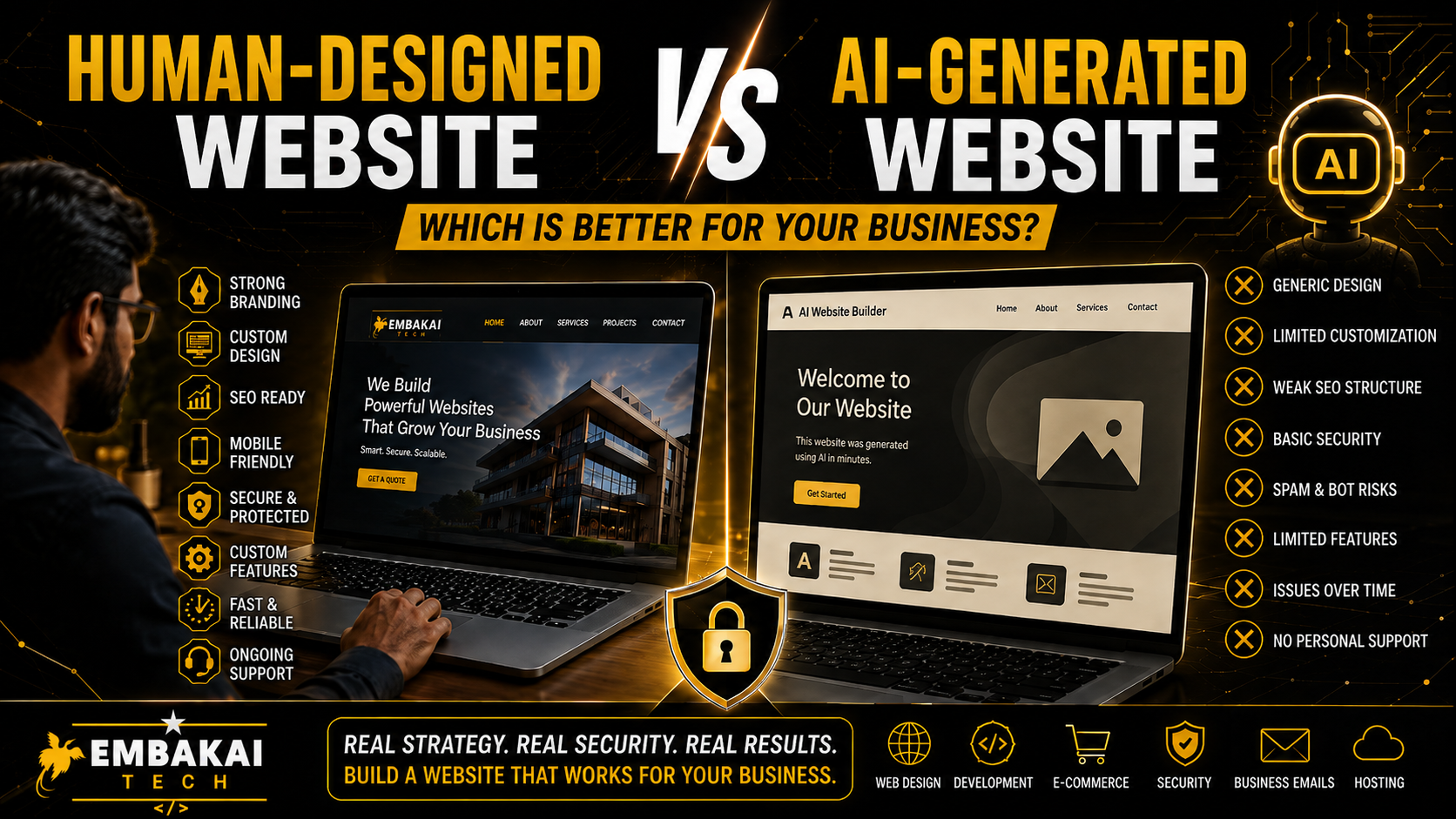
This guide explains the difference between a human-designed website and an AI-generated website, and which option is better for your business.
A human-designed website is planned, designed, developed, tested, and improved by a real person or team.
This may include a web designer, web developer, content writer, SEO specialist, hosting provider, security technician, or full-stack developer.
A proper human-designed website usually starts with understanding the business first.
A professional developer may ask:
This is important because a website should be built around business goals, not just around a template.
A human-designed website should be:
A good website is not only about appearance. It must also work properly behind the scenes.
An AI-generated website is created using artificial intelligence tools or AI website builders.
Usually, you enter basic information such as:
The AI tool then generates a website layout, text, images, sections, and sometimes basic branding suggestions.
This can be useful for:
But AI-generated websites often rely on templates, automated assumptions, and generic business content.
The website may look good at first, but it may not fully understand your market, your customers, your business process, your local context, your security risks, or your long-term plans.
AI can create a website quickly.
But quick does not always mean correct.
The biggest strength of AI is speed.
AI can generate a basic website quickly. It can create page sections, headlines, images, service descriptions, and call-to-action buttons in a short time.
But business websites need more than speed.
A proper website needs:
This is where human expertise becomes important.
A human developer looks at the whole picture. They do not just ask, “Can this page be generated?” They ask, “Will this website actually work for the business?”
That is the difference.
AI can generate a website.
A professional developer builds a business tool.
Your website should feel like your business.
That means it should match your:
AI can use your logo colours and create a layout, but branding is not just colour matching.
For example, if your business is a construction company, your website should communicate reliability, strength, completed projects, safety, and trust.
If your business is a law firm, your website should feel professional, structured, and serious.
If your business is an online shop, your website should make products easy to browse and buy.
If your business is a technology company, your website should feel modern, secure, fast, and solution-focused.
AI may not fully understand those differences unless a human gives very clear direction and checks the final output.
A human designer can study your business and create a website that fits your real brand identity.
AI is very useful for writing drafts.
It can help create:
But AI content can sound generic if it is not edited properly.
Many AI-generated websites use wording that looks clean but says very little. The content may sound like any other business in the same industry.
A strong business website needs specific content.
It should clearly explain:
AI does not automatically know your real projects, your clients, your local service areas, your pricing model, your business experience, your support process, or your unique selling points.
A human can take AI-assisted content and make it accurate, natural, local, and business-specific.
That is the better approach.
Use AI to assist. Do not let AI blindly publish your final business message.
SEO helps people find your website on Google.
AI can suggest keywords, headings, and meta descriptions, but SEO is not only about writing words.
A proper SEO-ready website needs:
For PNG businesses, local SEO is very important.
Your website may need to target searches such as:
An AI website builder may create a page, but it may not structure your full website around local search intent.
A human developer or SEO-focused designer can plan the pages properly so your website has a better chance of being found by real customers.
Security is one of the biggest differences between an AI-generated website and a professionally developed business website.
An AI website builder can create pages, layouts, images, and text quickly. Some platforms may also include basic protection, especially if they host the website for you. But that does not mean your full website setup is properly secured.
A real business website may handle contact forms, quote requests, login pages, online payments, customer accounts, file uploads, bookings, applications, business emails, and admin dashboards. Each of these areas can become a security risk if not configured properly.
This is where a human developer matters.
A professional developer can look at the full setup, not just the page design. They can make sure the website is protected from common problems such as spam bots, fake form submissions, weak admin access, poor hosting configuration, broken SSL, insecure file uploads, and unsafe payment workflows.
Important security features that AI cannot properly handle by itself include:
AI can recommend these things, but it cannot replace proper technical setup, testing, and monitoring.
For SMEs in Papua New Guinea, this matters because even a simple business website can be abused if it has public forms, admin access, customer information, or business email connected to it.
A hacked website, broken contact form, fake payment confirmation, or lost customer enquiry can damage trust quickly.
That is why security should not be treated as an extra feature. It should be part of the website plan from the beginning.
A human-designed and professionally developed website gives your business more control because the developer can plan the design, build the features, secure the system, test everything before launch, and provide support when problems happen.
AI website builders are usually best for simple websites.
They can help with:
But businesses often need more than that.
You may need a human developer if your website requires:
These features need planning, development, testing, security, and support.
AI can assist, but a human developer must still understand the workflow and make sure everything works correctly.
AI-generated websites can look cheaper at first.
You may only pay a monthly subscription, choose a template, generate content, and publish.
But hidden costs can appear later.
You may still need to pay for:
A cheap website becomes expensive when it fails to support the business properly.
A human-designed website may cost more upfront, but it can provide stronger long-term value when it includes proper planning, branding, SEO, security, support, and room for growth.
The real question is not only:
“Which option is cheaper?”
The better question is:
“Which option will support my business better over time?”
An AI-generated website can make sense when:
AI is useful for speed and ideas.
It is not always the best option for serious business infrastructure.
A human-designed website is better when:
For serious SMEs, organisations, online shops, consultants, contractors, schools, churches, NGOs, and service providers, human-designed websites offer more control, security, and long-term business value.
The best approach is not always human against AI.
The smarter approach is human strategy with AI assistance.
AI can help with:
But humans should handle:
AI is a tool.
A professional developer knows how to use that tool without letting it control the whole project.
But for a serious business, speed is not enough.
A proper website needs branding, mobile design, SEO, content strategy, secure hosting, protected forms, backups, admin access control, payment safety, email setup, and ongoing maintenance.
AI can generate a website, but it cannot fully replace a human designer or developer who understands your business, your customers, your local market, and your technical risks.
For businesses in Papua New Guinea, a website should do more than look good. It should build trust, help customers contact you, support Google visibility, protect your data, and grow with your business.
So which is better?
For a quick draft, AI is useful.
For a serious business website, a human-designed and professionally developed website is the better investment.
Embakai Tech Solutions helps SMEs, startups, organisations, and entrepreneurs in Papua New Guinea build secure, mobile-friendly, SEO-ready, and scalable websites.
We can help with website design, custom development, hosting, business emails, Cloudflare protection, spam protection, backups, admin dashboards, online shops, booking systems, and ongoing support.
Contact Embakai Tech Solutions today and build a website that works for your business.
Contact Embakai Tech Solutions for a focused review, implementation plan or quote for your organisation in Papua New Guinea.