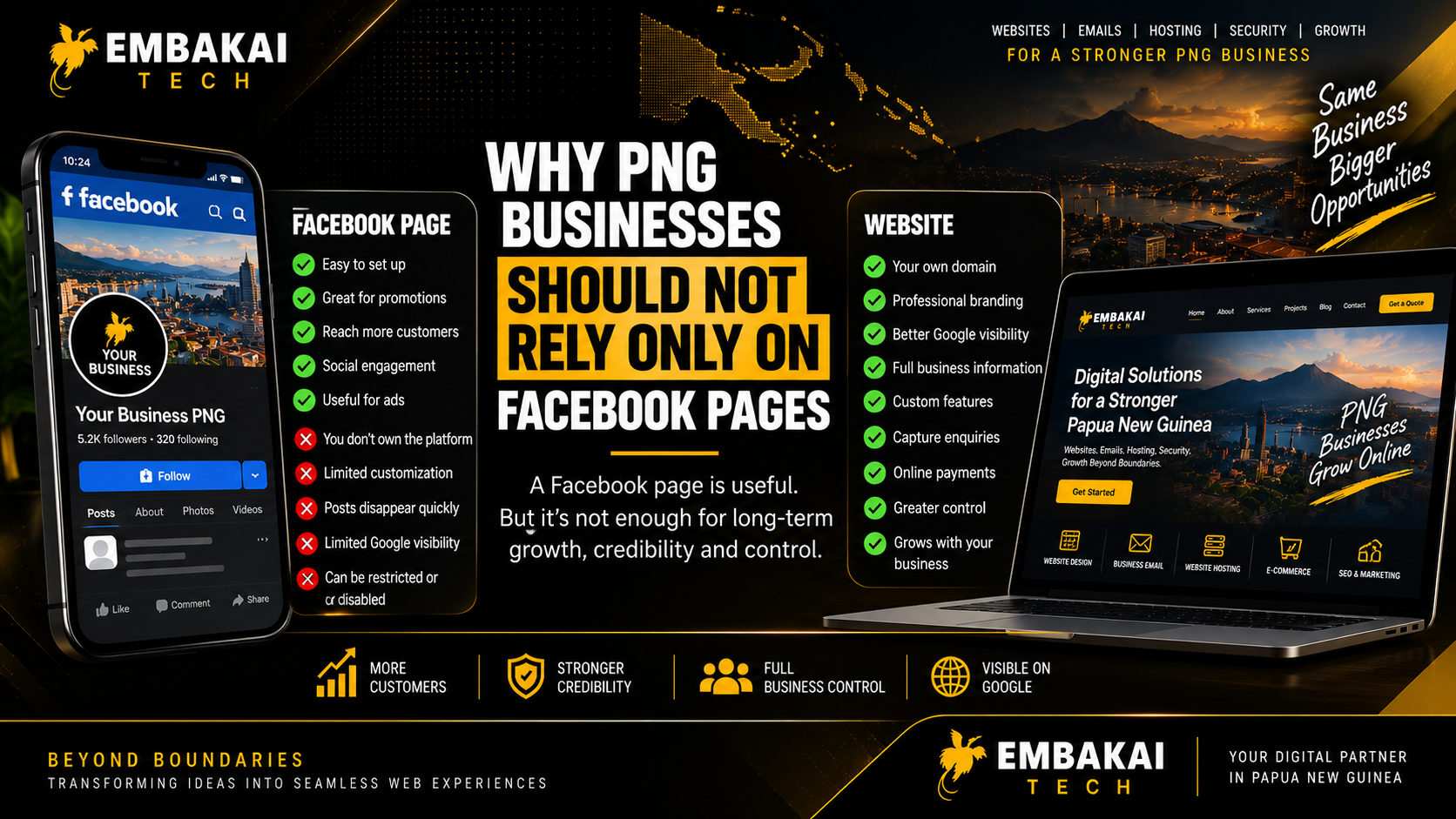
Facebook is one of the most useful online platforms for businesses in Papua New Guinea.
Many SMEs use Facebook to promote products, post updates, advertise services, communicate with customers, share contact details, and build an audience.
For some businesses, Facebook is the first place they establish an online presence.
That makes sense.
It is easy to create a page, simple to post content, familiar to customers, and useful for reaching people quickly.
But there is one major problem:
Relying only on Facebook means your business is building its entire online presence on a platform it does not control.
You do not control Facebook’s algorithm.
You do not control how your page is displayed.
You do not control what features Meta may change.
You do not control whether your organic posts reach the same number of followers next month.
And if your page is restricted, compromised, disabled, or inaccessible, your business may suddenly lose its main online presence.
A professional website gives your business something different.
It gives you your own domain, your own pages, your own structure, stronger control over your branding, better opportunities for Google Search visibility, and a platform that can grow with your business.
For PNG businesses, the strongest digital strategy is not Facebook or website.
It is:
Website + Facebook + Google + WhatsApp + professional email working together.
This guide explains why Facebook is useful, why it is not enough by itself, and why PNG businesses should build a professional website as the foundation of their long-term digital presence.
This article is not saying businesses should stop using Facebook.
Facebook remains valuable for:
For many PNG SMEs, Facebook is one of the easiest places to communicate with customers.
It works particularly well for businesses that regularly post:
The problem begins when Facebook becomes the only place where the business exists online.
Your Facebook page should be one part of your digital strategy.
It should not be your entire digital infrastructure.
This is one of the biggest differences between a Facebook page and a website.
Your Facebook page exists inside Meta's platform.
You are using their system.
Meta controls:
You may manage the page, but you do not control the platform underneath it.
A website is different.
With your own domain and hosting, your business has far more control over:
That independence becomes more important as the business grows.
Your website is a digital asset built around your company.
Your Facebook page is an account on someone else's platform.
Both are useful, but they should not be treated as the same thing.
Imagine a customer hears about your company and searches for your business online.
They find:
That creates a stronger impression than finding only a social media page.
A professional website allows you to present your business properly.
You can show:
Facebook is designed around posts.
A website is designed around your business.
That difference matters.
A potential corporate client, government organisation, NGO, supplier, partner, or investor may want more structured information than a Facebook feed can provide.
A website makes that information easier to find.
Facebook content is temporary by nature.
You may post something today and receive strong engagement.
A week later, it may be buried under newer posts.
A month later, customers may struggle to find it.
This is especially problematic for important business information such as:
A website gives important information permanent pages.
For example:
yourbusiness.com/services
yourbusiness.com/projects
yourbusiness.com/contact
These pages remain available until you update or remove them.
Customers do not need to scroll through six months of posts to find the information they need.
One of the biggest advantages of having a website is Google visibility.
Customers may search for services instead of searching for your business name.
For example:
A properly structured website gives your business pages that can target these types of searches.
Your website can have:
Each page gives search engines more information about your business.
A Facebook page does not give you the same level of control over SEO structure.
You cannot fully control:
If Google visibility matters to your long-term growth, a website should be part of your strategy.
Compare these two online identities:
facebook.com/yourbusiness
and
The second creates a stronger standalone business identity.
Your domain becomes part of your brand.
You can use it on:
You can also create professional email addresses such as:
This makes your online presence more consistent.
Your website, domain, and email can all carry the same business identity.
Instead of choosing between Facebook and a website, use them together.
Facebook is excellent for getting attention.
Your website is better for giving customers detailed information and moving them toward a business action.
For example:
You announce a new service.
The post gives a short explanation and includes a link.
The customer clicks the link and sees:
Facebook brings the customer in.
The website gives them the information needed to make a decision.
That is a stronger marketing flow.
Facebook feeds can become messy.
You may post about:
A new visitor may not understand the full range of services your business offers.
A website solves this by organising information into clear sections.
For example:
Each service can have its own page.
The customer can immediately understand what the business offers.
That structure is difficult to achieve with only a Facebook page.
Facebook controls how your page looks.
You can change:
But the overall interface remains Facebook's design.
Your website gives you much more control.
You can create a digital experience based on:
The website can feel completely like your business.
For businesses trying to build a professional corporate identity, this is important.
Your website becomes part of your brand, not just another social media profile.
Facebook Messenger is useful, but it is not always the best way to collect structured business enquiries.
A website can include forms designed specifically for your services.
For example:
Collect:
Collect:
Collect:
The information can then be:
Facebook Messenger cannot replace every business process.
PNG businesses do not have to choose between website and WhatsApp either.
Your website can have:
A customer can visit your website, read about the service, then immediately start a WhatsApp conversation.
That gives you the best of both platforms.
The website provides the information.
WhatsApp provides the conversation.
Facebook is useful for promoting products.
But a proper e-commerce website can give your business much more control over the buying process.
An online store may include:
Facebook can send customers to the store.
The website handles the transaction.
For businesses planning to grow online, this becomes increasingly important.
A website can start simple and become more advanced over time.
You may begin with:
Later, you can add:
A Facebook page cannot become your custom business platform.
A website can.
This makes a professional website a long-term digital investment.
Facebook gives you useful platform analytics.
But your own website gives you additional insight into how people interact with your business online.
Website analytics can help you understand:
This information can help improve your marketing.
For example, if one service page gets much more traffic than others, you may decide to promote that service more heavily.
If many people visit a page but few contact you, the page may need improvement.
A website gives you another layer of business intelligence.
When someone visits your Facebook page, Facebook decides much of what they see.
Ads, suggested content, notifications, comments, and platform navigation can all compete for their attention.
On your website, you control the experience.
You decide:
This matters for conversion.
A business website can be deliberately designed to turn visitors into:
Social media accounts can experience problems.
For example:
If Facebook is your only online presence, one account problem can seriously disrupt your business.
Having your own website gives customers another reliable place to find you.
Your website should display:
This reduces dependence on one platform.
A professional website also makes Facebook advertising more useful.
Instead of sending every advertisement to Messenger, you can send customers to specific landing pages.
For example:
Professional Business Email for PNG SMEs
The customer sees:
You can build separate landing pages for different campaigns.
This gives you more control over the customer's journey.
If your business wants to work with:
a professional website can strengthen your credibility.
These organisations may want to review:
A Facebook page alone may not provide the structured professional presence they expect.
A website can.
A simple way to understand the difference is:
They perform different jobs.
A smart business uses both.
Advantages:
Limitations:
Advantages:
Considerations:
A website requires more effort than creating a Facebook page, but it also gives the business significantly more control.
For most PNG SMEs, the best approach is not to abandon Facebook.
Instead, build a connected digital presence.
A strong setup could include:
Your main digital platform.
For marketing, community, updates, and advertising.
For direct customer communication.
For local search, maps, contact information, and reviews.
For formal communication.
Together, these platforms create a stronger online presence than any one platform alone.
A common question is:
“Do I really need a website if my business is still small?”
You do not necessarily need a large website.
A small business can start with a simple professional site containing:
You can expand later.
The goal is not to build the biggest website.
The goal is to establish a digital asset that belongs to your business and can grow with you.
That is good.
Keep using it.
But do not wait until Facebook stops working well before creating another channel.
Use your current Facebook audience to grow your website traffic.
For example:
Facebook can help build your website audience.
You do not have to replace one with the other.
Embakai Tech Solutions helps businesses, organisations, startups, and entrepreneurs in Papua New Guinea build professional digital platforms beyond social media.
Depending on business requirements, we can help with:
Facebook can remain an important part of your marketing.
The website becomes the digital foundation behind it.
It is useful for advertising, communication, promotions, customer engagement, and building an audience.
But it should not be your entire online presence.
A business that relies only on Facebook is depending heavily on a platform it does not control.
A professional website gives your business:
The strongest strategy is to use Facebook to attract people and your website to give them a professional place to learn more, trust your business, and take action.
Facebook helps you reach customers.
Your website helps you build a digital business asset.
Use both.
Embakai Tech Solutions can help you build a professional website that works alongside your Facebook page, WhatsApp, Google presence, and business email.
We build mobile-friendly, secure, SEO-ready websites for SMEs, startups, organisations, and businesses across Papua New Guinea.
Build an online presence your business can control and grow with.
Contact Embakai Tech Solutions today.
Contact Embakai Tech Solutions for a focused review, implementation plan or quote for your organisation in Papua New Guinea.